Showing posts with label Online Earning. Show all posts

Sunday, May 6, 2018


A binary option is a financial option in which the payoff is either some fixed monetary amount or nothing at all. The two main types of binary options are the cash-or-nothing binary option and the asset-or-nothing binary option. The former pays some fixed amount of cash if the option expires in-the-money while the latter pays the value of the underlying security. They are also called all-or-nothing options, digital options (more common in forex/interest rate markets), and fixed return options (FROs) (on the American Stock Exchange). While binary options may be used in theoretical asset pricing, they are prone to fraud in their applications and hence banned by regulators in many jurisdictions as a form of gambling. Many binary option outlets have been exposed as fraudulent. The U.S. FBI is investigating binary option scams throughout the world, and the Israeli police have tied the industry to criminal syndicates. The European Union is publishing regulations that will ban binary options trading.


The FBI estimates that the scammers steal $10 billion annually worldwide. The use of the names of famous and respectable people such as Richard Brandon to encourage people to buy fake "investments" is frequent and increasing. Articles published in the Times of Israel newspaper explain the fraud in detail, using the experience of former insiders such as a job-seeker recruited by a fake binary options broker, who was told to "leave [his] conscience at the door". Following an investigation by the Times of Israel, Israel's cabinet approved a ban on sale of binary options in June 2017, and a law banning the products was approved by the Knesset in October 2017.On January 30, 2018, Facebook banned advertisements for binary options trading as well as for crypto-currencies and initial coin offerings (ICOs). Google and Twitter announced similar bans in the following weeks.


Binary options "are based on a simple 'yes' or 'no' proposition: Will an underlying asset be above a certain price at a certain time?" Traders place wagers as to whether that will or will not happen. If a customer believes the price of an underlying asset will be above a certain price at a set time, he buys the binary option. If he believes it will be below that price, he sells the option. In the U.S. exchanges, the price of a binary is always under $100.

Investopedia described the binary options trading process in the U.S. thus:

[A] binary may be trading at $42.50 (bid) and $44.50 (offer) at 1 p.m. If you buy the binary option right then you will pay $44.50, if you decide to sell right then you'll sell at $42.50.

Let's assume you decide to buy at $44.50. If at 1:30 p.m. the price of gold is above $1,250, your option expires and it becomes worth $100. You make a profit of $100 - $44.50 = $55.50 (less fees). This is called being "in the money."

But if the price of gold is below $1,250 at 1:30 p.m., the option expires at $0. Therefore you lose the $44.50 invested. This is called being "out of the money."

The bid and offer fluctuate until the option expires. You can close your position at any time before expiry to lock in a profit or a reduce a loss (compared to letting it expire out of the money).
In the U.S., every binary option settles at $100 or $0, $100 if the bet is correct, 0 if it is not.


Many binary option "brokers" have been exposed as fraudulent operations. In those cases, there is no real brokerage; the customer is betting against the broker, who is acting as a bucket shop. Manipulation of price data to cause customers to lose is common. Withdrawals are regularly stalled or refused by such operations; if a client has good reason to expect a payment, the operator will simply stop taking their phone calls. Though binary options sometimes trade on regulated exchange, they are generally unregulated, trading on the Internet, and prone to fraud. The U.S. Securities and Exchange Commission (SEC) and Commodity Futures Trading Commission (CFTC) have issued a joint warning to American investors regarding unregulated binary options, and have forced a major operator, Banc de Binary, to cease operations in the United States and pay back all customer losses. In Israel, where a high concentration of such firms can be found, binary options trading was prohibited for Israeli customers in March 2016 on the grounds that it is a form of gambling and not a legitimate investment technique. On June 18, 2017, a ban on marketing binary options to customers outside of Israel was passed by the cabinet. It was approved by the Knesset in October, despite strong opposition from the binary options industry.


Wednesday, July 27, 2016

In finance, a contract for difference (CFD) is a contract between two parties, typically described as "buyer" and "seller", stipulating that the seller will pay to the buyer the difference between the current value of an asset and its value at contract time (if the difference is negative, then the buyer pays instead to the seller). In effect CFDs are financial derivatives that allow traders to take advantage of prices moving up (long positions) or prices moving down (short positions) on underlying financial instruments and are often used to speculate on those markets. For example, when applied to equities, such a contract is an equity derivative that allows traders to speculate on share price movements, without the need for ownership of the underlying shares.
CFDs were originally developed in the early 1990s in London as a type of equity swap that was traded on margin. The invention of the CFD is widely credited to Brian Keenan and Jon Wood, both of UBS Warburg,
They were initially used by hedge funds and institutional traders to hedge cost-effectively their exposure to stocks on the London Stock Exchange, mainly because they required only a small margin and because no physical shares changed hands avoided the UK tax of stamp duty. In the late 1990s CFDs were introduced to retail traders. They were popularized by a number of UK companies, characterized by innovative online trading platforms that made it easy to see live prices and trade in real time. The first company to do this was GNI (originally known as Gerrard & National Inter-commodities); GNI and its CFD trading service GNI touch was later acquired by MF Global. They were soon followed by IG Markets and CMC Markets who started to popularize the service in 2000. In June 2009, the UK regulator the Financial Services Authority (FSA) implemented a general disclosure regime for CFDs to avoid them being used in insider information cases. This was after a number of high-profile cases where positions in CFDs were used instead of physical underlying stock to hide them from the normal disclosure rules related to insider information.
CFDs are traded between individual traders and CFD providers. There are no standard contract terms for CFDs, and each CFD provider can specify their own, but they tend to have a number of things in common. The CFD is started by making an opening trade on a particular instrument with the CFD provider. This creates a ‘position’ in that instrument. There is no expiry date. Once the position is closed, the difference between the opening trade and the closing trade is paid as profit or loss. The CFD provider may make a number of charges as part of the trading or the open position. These may include, bid-offer spread, commission, overnight financing and account management fees.
The main risk is market risk as the contract is designed to pay the difference between the opening price and the closing price of the underlying asset. CFDs are traded on margin, and the leveraging effect of this increases the risk significantly. Margin rates are typically small and therefore a small amount of money can be used to hold a large position. It is this very risk that drives the use of CFDs, either to speculate on movements in financial markets or to hedge existing positions elsewhere. One of the ways to mitigate this risk is the use of stop loss orders. Users typically deposit an amount of money with the CFD provider to cover the margin and can lose much more than this deposit if the market moves against them.
Some financial commentators and regulators have expressed concern about the way that CFDs are marketed at new and inexperienced traders by the CFD providers. In particular the way that the potential gains are advertised in a way that may not fully explain the risks involved. In anticipation and response to this concern most financial regulators that cover CFDs specify that risk warnings must be prominently displayed on all advertising, web sites and when new accounts are opened. For example, the UK FSA rules for CFD providers include that they must assess the suitability of CFDs for each new client based on their experience and must provide a risk warning document to all new clients, based on a general template devised by the FSA. The Australian financial regulator ASIC on its trader information site suggests that trading CFDs is riskier than gambling on horses or going to a casino. It recommends that trading CFDs should be carried out by individuals who have extensive experience of trading, in particular during volatile markets and can afford losses that any trading system cannot avoid.
CFDs, when offered by providers under the market maker model, have been compared to the bets sold by bucket shops, which flourished in the United States at the turn of the 20th century. These allowed speculators to place highly leveraged bets on stocks generally not backed or hedged by actual trades on an exchange, so the speculator was in effect betting against the house. Bucket shops, colorfully described in Jesse Livermore's semi-autobiographical "Reminiscences of a Stock Operator", are illegal in the United States according to criminal as well as securities law.

Friday, June 10, 2016

Magento is an open-source e-commerce platform written in PHP. The software was originally developed by Varien Inc., a US private company headquartered in Culver City, California, with assistance from volunteers. Varien published the first general-availability release of the software on March 31, 2008. Roy Rubin, former CEO of Varien, later sold a substantial share of the company to eBay, which eventually completely acquired and then spun off the company. According to the research conducted by ahead Works in May 2015, Magento's market share among the 30 most popular e-commerce platforms is about 29.8%.
On November 17, 2015, Magento 2.0 was released, with an aim to provide new ways to heighten user engagement, smooth navigation, conversion rates and overall revenue generation, it has well-organized business user tools speed up build up time and enhances productivity. Table locking issues have been considerably reduced, Improved Page Caching and also allows in streamlining Guest checkout process for existing users, Enterprise-grade sociability, improved performance and better code base are only a few benefits of new Magento version. Magento employs the MySQL/MariaDB relational database management system, the PHP programming language, and elements of the Zend Framework. It applies the conventions of object-oriented programming and model–view–controller architecture. Magento also uses the entity–attribute–value model to store data.
Magento Community Edition is an open-source eCommerce platform. Developers can implement the core files and extend its functionality by adding new plug-in modules provided by other developers. Since the first public beta version was released in 2007, Community Edition has been developed and customized in order to provide a basic eCommerce platform. The current release and each of the previous historical release versions of the 1.X and 2.X version branches of  Magento Community Edition are available on the Magento Commerce, Inc. website for download as singe-file downloads Development of the 2.X version branch of Magento CE is coordinated publicly on GitHub. The latest actively supported versions of  Magento Community Edition are CE 1.9.2.4 and 2.0.4 released on March 31, 2016.
Magento Enterprise Edition is derived from the Magento Community Edition and has the same core files. Unlike Community Edition, this is not free, but has more features and functionality. This edition is designed for large businesses that require technical support with installation, usage, configuration, and troubleshooting. Although Magento Enterprise has annual maintenance fees, neither Community nor Enterprise Editions include hosting. The Magento team develops Enterprise Edition by cooperating with users and third parties. Development on the 2.X branch of Magento EE is coordinated publicly on GitHub. The latest actively supported versions of  Magento Enterprise Edition are EE 1.14.2.4 and EE 2.0.4 released on March 31, 2016.
Magento Go was a cloud-based eCommerce solution that included web hosting by Magento Inc. It was launched in February 2011 to support small businesses by providing an option that did not require software installation. Magento Go was the least customizable platform, though it still had built-in modules and could have Magento extensions enabled for more functionality. On July 1, 2014, Magento Inc. announced that they would be shutting down the Magento Go platform on February 1, 2015.
Magento Go was a cloud-based eCommerce solution that included web hosting by Magento Inc. It was launched in February 2011 to support small businesses by providing an option that did not require software installation. Magento Go was the least customization platform, though it still had built-in modules and could have Magento extensions enabled for more functionality. On July 1, 2014, Magento Inc. announced that they would be shutting down the Magento Go platform on February 1, 2015.
There are four different Magento certifications. Three of them aim to prove developers' competency in implementing modules; one (Certified Solution Specialist) targets business users (consultants, analysts, project managers). Magento Front End Developer Certification is mainly focused on improving the user interface (UI) of built-in applications. This certification is related with templates, layouts, Java script, and CSS. Magento Developer certification is geared toward back end developers who implement the core modules. The Plus certification tests deep understanding of Magento Enterprise modules and the entire architecture.


Shopify is a Canadian e-commerce company headquartered in Ottawa, Ontario, that develops computer software for online stores and retail point-of-sale systems.Shopify was founded in 2004, and was initially based on earlier software written by its founders for their online snowboard store. The company reports that it has 200,000 merchants using its platform, with total gross merchandise volume exceeding $10 billion.
Shopify was founded in 2004 by Tobias Lütke, Daniel Weinand, and Scott Lake after attempting to open Snowdevil, an online store for snowboarding equipment. Unsatisfied with the existing e-commerce products on the market, Lütke, a computer programmer by trade, decided to build his own. In June 2009, Shopify launched an API platform and App Store. The API allows developers to create applications for Shopify online stores and then sell them on the Shopify App Store. Several companies have developed apps that integrate with the Shopify platform.
In April 2010 Shopify launched a free mobile app on the Apple App Store in May 2010. The app lets Shopify store owners view and manage their stores from iOS mobile devices. In 2010, Shopify started its Build-A-Business competition, in which participants create a business using its commerce platform. The winners of the competition receive cash prizes and mentor-ship from entrepreneurs, such as Richard Branson, Eric Ries and others. Shopify was also named Ottawa’s Fastest Growing Company by the Ottawa Business Journal in 2010. The company received $7 million from an initial Series A funding round in December 2010. Its Series B funding round generated $15 million in October 2011.
In February 2012 Shopify acquired Select Start Studios Inc ("S3"), a mobile software developer, along with 20 of the company's mobile engineers and designers. On April 14, 2015, Shopify filed for an IPO on the New York Stock Exchange and Toronto Stock Exchange under the symbols "SHOP" and "SH" respectively. Shopify went public on May 21, 2015, and in its debut on the New York Stock Exchange, Shopify started trading at $28, more than 60% higher than its USD $17 offering price, with its IPO raising more than$131 million.


Thursday, June 2, 2016

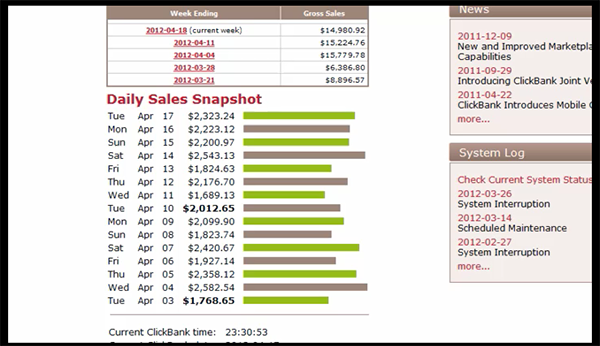
ClickBank is a privately held online marketplace for digital information products. It aims to serve as a connection between digital content creators (also known as vendors) and affiliate marketers, who then promote them to consumers. In 2011 Revenue Magazine named the company as the top affiliate network in the United States. The company has headquarters in Boise, Idaho, and offices in Broomfield, Colorado.
The company is a subsidiary of Keynetics, and is the sister company of Kount, an online security company. It was founded in 1998 by Tim and Eileen Barber.In 2011, the site had attracted over 1,500,000 affiliate marketers, approximately 100,000 of whom were designated as 'active' at any given time. In June 2011 the company claimed to have paid affiliates and vendors over $1.8 billion, processed 35,000 transactions per day, and generated over $350M in annual revenue. It offered over 46,000 individual products to its affiliate marketers, and provided services in over 200 countries.  
Becoming a Clickbank Vendor/Seller
 The benefit to becoming a vendor is two-fold. First, you are truly entering the arena of doing business online. You are moving from being a consumer to being a producer. And producers get paid.
Second, as it related to marketing, you are getting your product EXPOSED to a large number of active “affiliate marketers” who make it a goal to sell other people’s products and services to earn a commission.
Here are the easy steps for getting set up as a ClickBank vendor:
1.    Sign Up as a Vendor
2.    Create a Sales Page and Receipt Page
3.    Make a Payment Link & Add to Your Page
4.    Complete Product Profile within Account
5.    Complete Company Profile within Account
6.    Test Your Payment Link (Paypal is Default Option)
7.    Request Product Approval (Takes 2-10 Days)
8.    Pay One-Time $49.95 Activation Charge
9.    Wait for Approval
You can also sell your products through multiple affiliate directories so don’t think you are limited in any way by creating a vendor account. Depending on the shopping cart/order processing software you use, you can offer potential customers a choice of where they make their purchase. You can also create any number of sales pages – one for clickbank, one through an ebay store, etc. 
Becoming a Clickbank Affiliate
Most people who first get started online do not have their own digital product, membership site or software to sell. Instead the sell other people’s products and services in return for a commission. This is commonly called becoming an affiliate marketer and could be one of the reasons why you hear “clickbank scam” on occasion. What happens is people will buy into a particular “make money” program that teaches them how to become an affiliate marketer and these products usually encourage beginners to start by promoting Clickbank products. So the new person follows the instructions, does not have any great success and then screams “clickbank scam” out of desperation. When, in fact, their failure had absolutely nothing to do with Clickbank. But it had everything to do with their marketing methods and the instructions of the product they purchased. Becoming a ClickBank affiliate is a quick and easy process. By following the three simple steps below, you’ll be on your way to becoming a successful affiliate in no time! If you’re looking to get started creating and selling your own products as a vendor.
Create a FREE account
Find a Product or Two to Promote
Start Marketing  
Clickbank Scam or Not?
 Some of the product you may purchase through the platform could be rightfully called a scam – or at least not worth the price you might pay. But, this isn’t Clickbank’s fault. And you can always ask for a refund which is usually promptly given.


Monday, May 30, 2016

Skrill (formerly Moneybookers) is an e-commerce business that allows payments and money transfers to be made through the Internet, with a focus on low-cost international money transfers. It is owned and operated by Skrill Limited, a UK-based company registered as a Money Service Business with Her Majesty's Revenue and Customs, regulated by the Financial Conduct Authority and licensed to operate within the European Union.
The moneybookers.com domain was first registered on 17 June 2001. On 27 July 2001, a company named Moneybookers Limited was incorporated in the United Kingdom.. The moneybookers.com website along with the online payment system was launched on 1 April 2002.
In March 2007, Moneybookers was bought by Invest corp Technology Partners for €105 million and as of 9 March 2009, it was put up for sale by its owners for an estimated £365 million. In 2008, Moneybookers claimed to operate in 200 countries of the world and handle over 6 million accounts. In February 2010, The Sunday Times ranked Moneybookers as the fastest growing private equity backed firm in the United Kingdom based on profits. In 2011, the company's customer base reached 25 million, including 120,000 merchant accounts, In August 2013, CVC Capital Partners acquired Skrill for €600 million. In March 2015, Optimal Payments, the parent company of the Skrill's rival Neteller, announced its official proposal for acquisition of Skrill Group for €1.1 billion. The deal is to be finalized in the third quarter of 2015 according to the parties. In September 2011, Moneybookers announced that they would re-brand their service as Skrill. The re-branding of the product was completed in 2013.
The privately owned Better Business Bureau currently has Skrill USA with a "D-" rating as of April 2016, The result of 66 complaints closed with BBB in last 3 years. However, abrupt account freezes and withheld funds are an area of concern for customers where Skrill accounts are linked to credit card companies and banks as Skrill has entered into contracts favorable to these financial institutions when disputes arise. Many customer reviews are favorable, for example in a 2011 survey by the online seller news blog eCommerce Bytes, Skrill received the second highest ranking out of all payment services. Customers can purchase a Skrill-branded prepaid card, linked to the account, in one of the four currencies: USD, EUR, PLN, and GBP. High-turnover customers are offered premium membership called "Skrill VIP" that includes additional features, such as a security token, multi-currency accounts and the ability to earn loyalty points.For businesses, Skrill offers a payment gateway, escrow payments as well as web SMS and fax sending services. Unlike some of its competitors, Skrill does not usually get involved in merchandise disputes, and the availability of credit card charge backs may be limited.

Wednesday, May 25, 2016

Affiliate marketing is a type of performance-based marketing in which a business rewards one or more affiliates for each visitor or customer brought by the affiliate's own marketing efforts. The industry has four core players: the merchant (also known as 'retailer' or 'brand'), the network (that contains offers for the affiliate to choose from and also takes care of the payments), the publisher (also known as 'the affiliate'), and the customer. The market has grown in complexity, resulting in the emergence of a secondary tier of players, including affiliate management agencies, super-affiliates and specialized third party vendors.
Affiliate marketing overlaps with other Internet marketing methods to some degree, because affiliates often use regular advertising methods. Those methods include organic search engine optimization (SEO), paid search engine marketing (PPC - Pay Per Click), e-mail marketing, content marketing and in some sense display advertising. On the other hand, affiliates sometimes use less orthodox techniques, such as publishing reviews of products or services offered by a partner.
Affiliate marketing is commonly confused with referral marketing, as both forms of marketing use third parties to drive sales to the retailer. However, both are distinct forms of marketing and the main difference between them is that affiliate marketing relies purely on financial motivations to drive sales while referral marketing relies on trust and personal relationships to drive sales.

Affiliate marketing is frequently overlooked by advertisers.  While search engines, e-mail, and website syndication capture much of the attention of online retailers, affiliate marketing carries a much lower profile. Still, affiliates continue to play a significant role in e-retailer's marketing strategies.

The foreign exchange market (forex, FX, or currency market) is a global decentralized market for the trading of currencies. This includes all aspects of buying, selling and exchanging currencies at current or determined prices. In terms of volume of trading, it is by far the largest market in the world. The main participants in this market are the larger international banks. Financial centers around the world function as anchors of trading between a wide range of multiple types of buyers and sellers around the clock, with the exception of weekends. The foreign exchange market does not determine the relative values of different currencies, but sets the current market price of the value of one currency as demanded against another.
The foreign exchange market works through financial institutions, and it operates on several levels. Behind the scenes banks turn to a smaller number of financial firms known as “dealers,” who are actively involved in large quantities of foreign exchange trading. Most foreign exchange dealers are banks, so this behind-the-scenes market is sometimes called the “interbank market”, although a few insurance companies and other kinds of financial firms are involved. Trades between foreign exchange dealers can be very large, involving hundreds of millions of dollars. Because of the sovereignty issue when involving two currencies, forex has little (if any) supervisory entity regulating its actions.
The foreign exchange market assists international trade and investments by enabling currency conversion. For example, it permits a business in the United States to import goods from European Union member states, especially Eurozone members, and pay Euros, even though its income is in United States dollars. It also supports direct speculation and evaluation relative to the value of currencies, and the carry trade, speculation based on the interest rate differential between two currencies.
In a typical foreign exchange transaction, a party purchases some quantity of one currency by paying with some quantity of another currency. The modern foreign exchange market began forming during the 1970s after three decades of government restrictions on foreign exchange transactions (the Bretton Woods system of monetary management established the rules for commercial and financial relations among the world's major industrial states after World War II), when countries gradually switched to floating exchange rates from the previous exchange rate regime, which remained fixed as per the Bretton Woods system.
The foreign exchange market is unique because of the following characteristics:
·         its huge trading volume representing the largest asset class in the world leading to high liquidity;
·         its geographical dispersion;
·         its continuous operation: 24 hours a day except weekends, i.e., trading from 22:00 GMT on Sunday (Sydney) until 22:00 GMT Friday (New York);
·         the variety of factors that affect exchange rates;
·         the low margins of relative profit compared with other markets of fixed income; and
·         the use of leverage to enhance profit and loss margins and with respect to account size.
As such, it has been referred to as the market closest to the ideal of perfec competition, notwithstanding currency intervention by central banks. According to the Bank for International Settlements, the preliminary global results from the 2013 Triennial Central Bank Survey of Foreign Exchange and OTC Derivatives Markets Activity show that trading in foreign exchange markets averaged $5.3 trillion per day in April 2013. This is up from $4.0 trillion in April 2010 and $3.3 trillion in April 2007. Foreign exchange swaps were the most actively traded instruments in April 2013, at $2.2 trillion per day, followed by spot trading at $2.0 trillion. According to the Bank for International Settlements, as of April 2010, average daily turnover in global foreign exchange markets is estimated at $3.98 trillion, a growth of approximately 20% over the $3.21 trillion daily volume as of April 2007.
Some firms specializing on foreign exchange market had put the 
average daily turnover in excess of US$4 trillion. The $3.98 trillion break-down is as follows:
·         $1.490 trillion in spot transactions
·         $475 billion in outright forwards
·         $1.765 trillion in foreign exchange swaps
·         $43 billion currency swaps
·         $207 billion in options and other products


Translate

Categories

loading...